

I went to head out for a run recently, and my watch was at 5% battery.
Not a big deal. The shoes were already on. It was the same road I always run. My legs had no idea what was or wasn’t strapped to my wrist. And still I stood there for a second and felt the air go out of the whole thing, and caught myself thinking I’ll just go tomorrow.
Nothing about the run had changed. The only thing missing was the ability to record it.
That’s what I want to talk about, because I don’t think the answer is to throw the watch in a drawer and go be a purist about it. I like the watch. I like watching numbers get better. I built an entire dashboard to run my life and my business, and I’m not about to tell you tracking is the problem.
The problem is what we measure, and the order we measure it in.
Attendance first. Performance later.
Here’s the rule I’ve landed on: you measure whether you showed up until showing up is reliable. Only then do you get to measure how well you did.
Most of us do it backwards. We pick up the output metric on day one — the pace, the word count, the revenue number, the subscriber count — and start grading ourselves against it while we’re still figuring out whether we can even get out the door three times a week. Then we miss twice, the number looks bad, and we conclude we’re bad at the thing. We’re not bad at the thing. We measured something we hadn’t earned the right to measure yet.
I want to improve my base running cadence. That’s a real goal, not a vanity one. I know I’m capable of being faster than I am, and I want that number to keep moving in the right direction as I get older, not the other way. Measuring it is exactly the right thing to do — eventually.
But there was a stretch where I was following a training plan built for someone running five or six days a week, and I was running twice. Every single workout in that plan was a failure by definition before I laced up. The plan wasn’t wrong. It just wasn’t mine yet. Two runs a week is a win right now. Get that solid, and then the cadence number becomes useful information instead of a weekly reminder that I’m behind.
The same logic killed a handful of app subscriptions I’ve cancelled over the last year. They weren’t bad apps. They were all asking me to perform at a level I hadn’t stabilized attendance for.
I built the flaw into my own tool
This is the part I’d rather not admit.
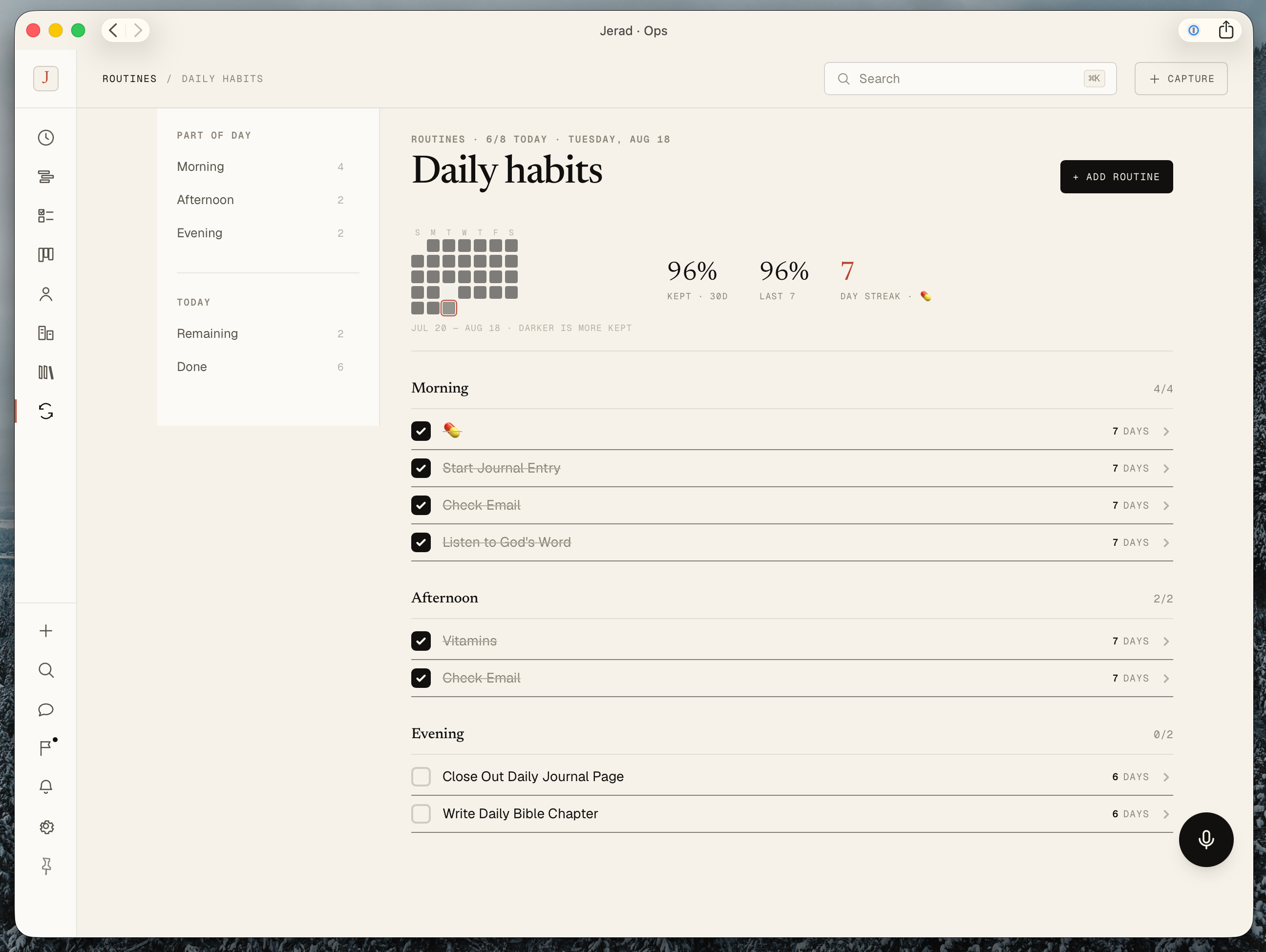
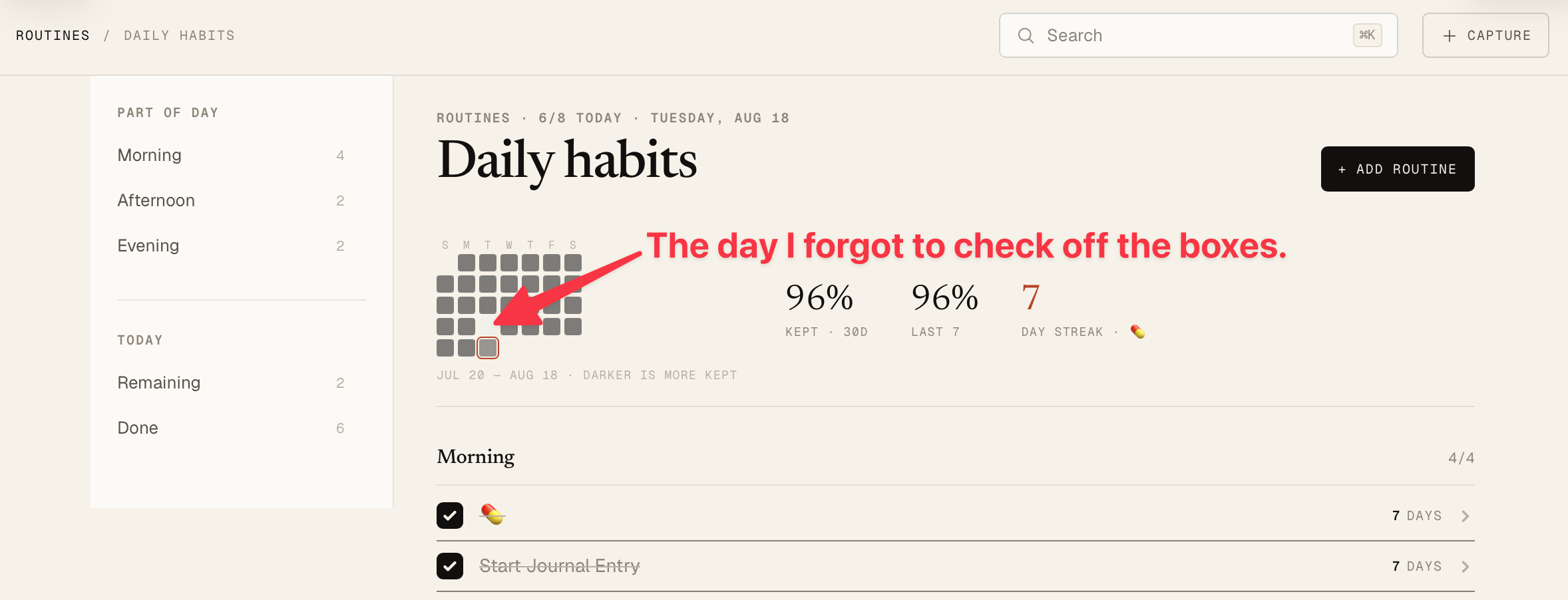
My dashboard has a routine section. Small daily things, genuinely important, things I want to do every day. I check them off. Miss one, and the streak resets to zero.
And worse — and this is the part that finally made something click — if I do the thing and forget to check the box, it still resets to zero.
So what is that metric actually measuring? Not whether I lived the day well. It’s measuring whether I logged it. It tracks my relationship with the checkbox, not my relationship with the thing.
Once you see that, you start seeing it everywhere. A tracked system will quietly train you to optimize for the tracking. Not because you’re dishonest, but because the tracking is the part that gives you feedback, and feedback is what we steer by.
What makes this worth writing about instead of just fixing quietly is that the same dashboard gets it right somewhere else. The parts tied to actual client commitments work fine — there’s a real deliverable, a real person on the other end, a real consequence. Those measurements point at the thing itself. The routine section points at a checkbox and hopes I’m honest enough for that to be the same.
Same tool. Same author. One section I trust and one I don’t.
Streaks are great at starting things and terrible at keeping them
I want to be fair to streaks, because they work. A streak is a genuinely good mechanism for the first few weeks of anything. It gives you a reason to do the thing on the day you don’t feel like it, and that’s precisely the day that matters when you’re building something new.
The failure comes later. Once the habit is real, the streak stops being a support and becomes a liability, because now you have something to lose. You get sick. You travel. Life does what life does. And the number that was pulling you forward turns around and tells you that you’re back at nothing.
Nobody is actually back at nothing. The body remembers. The skill remembers. Only the counter forgot.
The one thing I do without a scoreboard
I play drums.
I wanted to for years and finally just started, which is not usually how I operate — I tend to avoid things I won’t be immediately good at. I am not immediately good at drums. I enjoy them anyway.
I used a practice app for a while. It had a daily streak. I dropped it, because losing the streak was more discouraging than practicing was rewarding. Now I pull up a video and play along when I have time.
Here’s what I notice: I put in less time on drums than I’d like, and I feel absolutely no guilt about it. None. Compare that to almost anything else I fall short on, where the shortfall becomes a whole internal conversation.
The only difference I can find is that nothing is counting.
What I actually changed
It would be easy to leave this as an interesting observation. Observations don’t do anything. Here’s what’s different now.
I cancelled the subscriptions that were setting terms I couldn’t meet. Not because the apps were bad, but because I was paying monthly for a standard I hadn’t earned my way up to yet.
I stopped running someone else’s training plan and defined success as two runs a week. Cadence is still the goal. It’s just not the scoreboard yet.
I deleted the drumming app and kept the drums.
And for most of my working life I picked a tool and made myself fit it. If the app measured streaks, I measured streaks. The tool was fixed and I was the variable. Building my own dashboard with Claude Code flipped that — my data lives where I put it, and when a measurement isn’t serving me I change the measurement instead of changing myself to suit it.
Which is how I know the streak counter in the routine section is coming out. I want something that shows me I showed up without requiring me to prove I logged it. I haven’t settled on what that looks like yet, and that’s fine — it’s a design problem now, not a character problem, and design problems get solved.
Your turn
Don’t overhaul anything. Just do this.
Pick the number in your life that currently makes you feel the worst. The one you don’t want to open the app and see.
Now ask whether you’re consistent enough at that thing yet for that number to be a fair measure of you.
If the answer is no, you don’t have a discipline problem. You have a sequencing problem, and those are much easier to fix. Put the output metric down. Pick up an attendance metric — did I show up at all, in any form, even a bad one — and leave it there until showing up stops being the hard part.
The driveway
I went on the run.
I don’t know how far it was. Somewhere around my usual loop, at whatever pace my legs felt like giving me. There is no record of it anywhere and it made me exactly as much fitter as it would have if the watch had been charged.
It counted. It just wasn’t counted.
Those turn out to be two very different things, and I’d spent a long time treating them as one.
~Jerad