

A month ago, I posted a video walking through a system I built in Claude Code to manage my entire life, tasks, projects, content, and the people I want to stay connected to, all in one place. I figured a few hundred people might find it useful.
It’s now been watched more than 72,000 times. Hundreds of you subscribed here because of it. Some of you became paid subscribers, thank you! And a lot of you have asked the same two things: can I see the scope document, and will you make this available to build myself?
This post is my honest 30-day report. What’s held up, what hasn’t, what I’ve changed since filming, and a few things I didn’t expect, including why I’ve decided not to turn this into a product you can buy.
The second half of this post is for paid subscribers. That’s where I’m sharing the actual scope document as a download, along with the specific lessons from getting it ready for someone other than me to use. But the reckoning comes first, and it’s for everyone.
What’s actually working
The task and project manager is the heart of it, and it’s been better than I hoped.
The thing I keep coming back to is voice capture. I can yap into my phone or my watch: “add a task to follow up with the Glacier Precast team about the calculator next Tuesday,” and it goes exactly where it’s supposed to go. The OpenAI connection transcribes what I said, the Anthropic API parses it, and the system places it correctly. I’ve tried to do versions of this in other tools for years and something always went wrong. The task would land in the wrong project, or the date wouldn’t parse, or it’d just sit in an inbox I had to sort later. This doesn’t do that. It mostly just works.
That’s the part that surprised me. Not that I could build it, but that it would hold up across a full month of real, messy, distracted daily use.
What I’ve changed since the video
Thirty days of living in something teaches you things no amount of planning can.
I restructured what domains are. In the video they were doing too much, and the boundaries between them were fuzzy. I tightened the definition so the hierarchy actually makes sense.
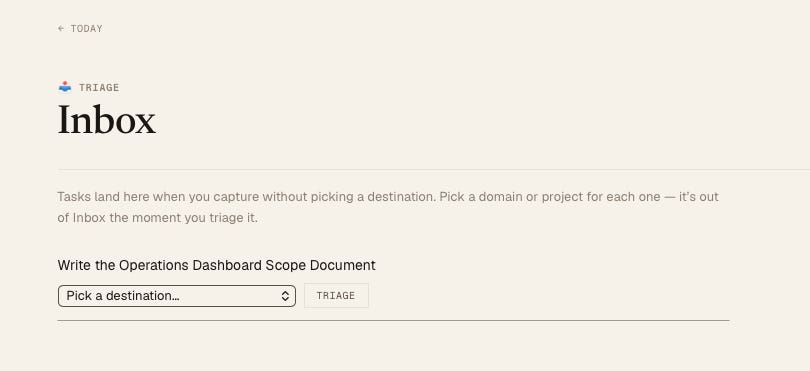
I added an Inbox. This was the bigger fix. Originally, if the system wasn’t confident where a captured item belonged, it would make its best guess, and sometimes that guess was wrong, which meant hunting for misplaced tasks later. Now anything it can’t confidently place goes to an Inbox temporarily, and I sort it when I have a moment. That one change removed a quiet source of distrust. I no longer wonder whether something I captured vanished into the wrong corner.
I also worked out a long list of small bugs and inconsistencies, the kind of thing you only find by using a tool every day. None of them dramatic on their own. All of them the difference between a system you trust and one you start avoiding.
What I’ve struggled with
Not everything has earned its place.
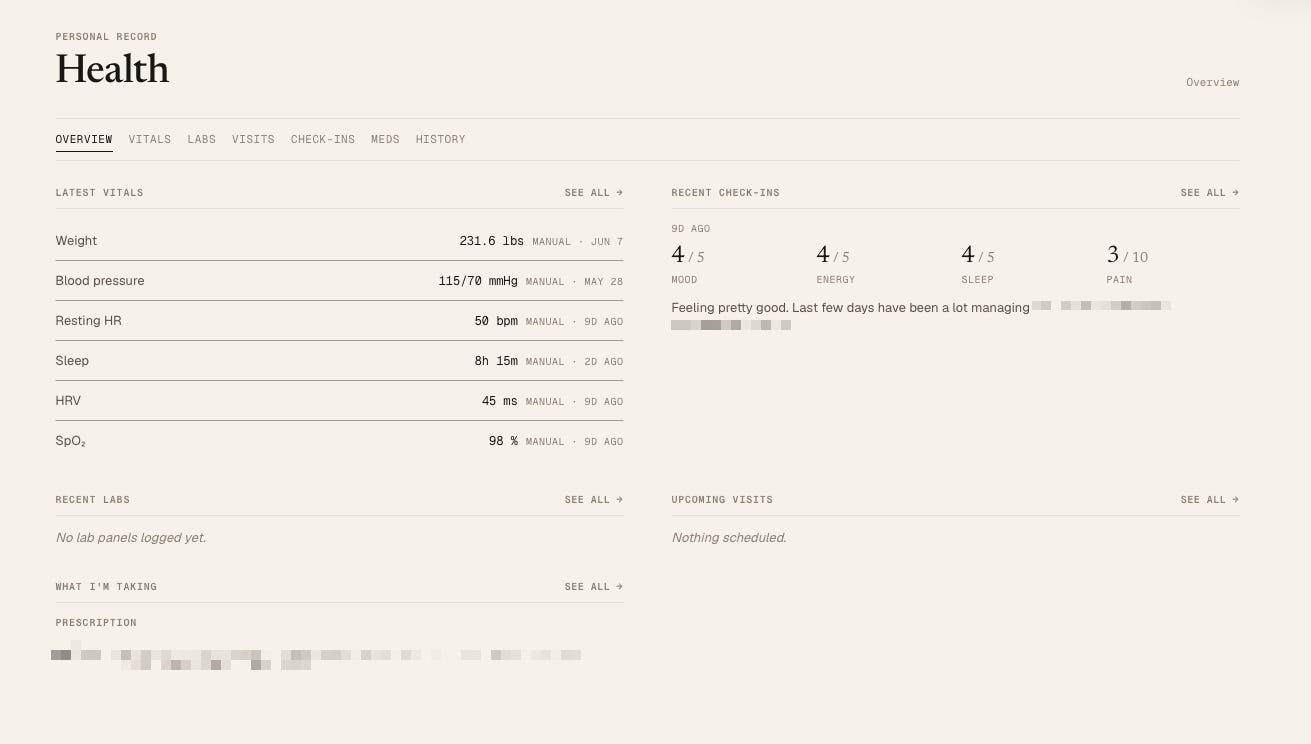
I added health tracking, with the idea that it could double as my personal medical record. Honestly, I’m not sure it’s useful yet. It’s there, I’m using it lightly, but I haven’t found the workflow that makes it indispensable. It might become valuable. It might be a feature I added because I could, not because I needed it.
The Slipping section, the part of the Today view meant to surface projects that have fallen behind, has been the hardest thing to tune. The problem is that different projects have completely different rhythms. A client deliverable that goes quiet for three days might be a real problem. A long-term personal project that goes quiet for two weeks might be completely fine. Teaching the system to know the difference, to be sensitive enough to catch real drift without crying wolf, is still a work in progress.
A confession about scope creep
In my line of work there’s a term for what happened to this project: scope creep. It’s when the work quietly expands beyond what you originally set out to do.
This dashboard didn’t start as a self-contained system. The original idea was much smaller, just a dashboard that pulled information in from everywhere else. A single pane of glass over my existing tools. That’s it.
Now it’s its own system, with all the data living inside it except for the Google Calendar connection. Health tracking. A personal CRM. A full content pipeline. A library of notes, quotes, and book highlights. That is a lot more than “just a dashboard.”
Some of that expansion was good; the connectedness is the whole reason it works. But some of it was me doing the thing I’m prone to: going down a rabbit hole, adding capability because building is fun, ending up somewhere I didn’t plan to go. This isn’t the first dashboard I’ve tried to build for myself. And it’s not the first time I’ve spent real time developing something, I did it with two WordPress plugins, that grew beyond what I actually needed.
I’m telling you this because the lesson of this whole project isn’t “look what I built.” It’s that these days you can build almost anything you want, and that is both good and dangerous. The barrier to creation has collapsed. Which means the discipline has shifted from “can I build this?” to “should I, and where do I stop?”
Why I’m not making this a product
A number of you have asked me to turn this into something you can sign up for and pay to use. I’ve thought about it. And I’ve decided not to; at least not as a hosted product.
Here’s my honest reasoning. This solves a very specific problem for a specific kind of person: someone who, like me, wants absolutely everything in one place and is willing to live inside a single system to get it. That’s a real person. But it’s a narrow one. The more I tried to make this work for everyone, the more I’d have to generalize away the exact specificity that makes it useful. I’d end up rebuilding Notion or ClickUp, tools that already exist and are excellent at being general.
I’m also not an AI guru, and I have no interest in becoming one. What I try to bring to the spaces I share in, this project, my tech and camera channels, is discernment and realistic expectation. I’m not a sensationalist. I approach most things with some skepticism while recognizing when optimism is warranted. Turning this into a product would pull me toward hype I don’t believe in, and toward maintaining something for a customer base that would be better served by tools built for scale.
So I’m not selling you the dashboard.
But I will give you the blueprint.
The rest of this post is for paid subscribers. Below, I’m sharing the actual scope document as a download, walking through what it took to make it usable for someone other than me, sanitizing my credentials, reframing my personal assumptions, and weighing whether you should build this with Claude Code or wait for a possible public GitHub release.